Home Energy Storage Battery Parameters
News
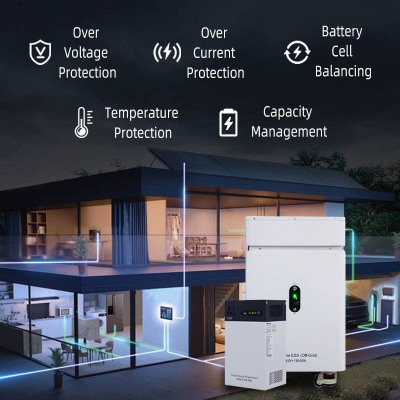
Capacity (kWh) determines how much electricity can be stored. For example, a 3kWh battery can support a 100W appliance for 30 hours or a 500W appliance for 6 hours. Households need to match their capacity to their daily electricity consumption (such as air conditioning in summer and underfloor heating in winter) and solar power generation; it is generally recommended to configure the capacity to be 1.5-2 times the daily electricity consumption.
Power (kW): Affects discharge speed. Instantaneous power needs to cover the maximum household load (such as simultaneously starting an air conditioner and microwave oven). It is generally recommended to choose a product with a power output of 3kW or higher to avoid overload protection triggering.
Cycle Life: Refers to the number of charge-discharge cycles before the battery's capacity decays to 80%. The cycle life of lithium-ion batteries is typically 3000-6000 cycles. Based on one charge-discharge cycle per day, this translates to 8-16 years of use.
Charge/discharge efficiency, the ratio of input to output capacity, is crucial. Lithium-ion batteries typically boast efficiencies above 90%, while lead-acid batteries reach approximately 80%. High efficiency translates to less energy loss, resulting in lower electricity costs over the long term.
Safety performance: Batteries must meet international safety certifications such as UL9540 and IEC62619 and possess overcharge, over-discharge, short-circuit, and temperature protection functions. Lithium iron phosphate batteries, due to their superior thermal stability, offer better safety than ternary lithium batteries.
 Send Email
 Joyful Power
 19822673336