Types Of Solar Panels
News
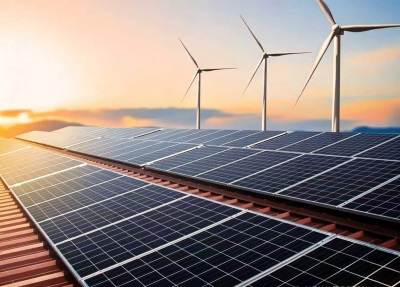
Solar panels come in many varieties, primarily classified by materials, structure, and application. Below are common types of solar panels and their characteristics:
Monocrystalline Silicon Solar Panels: Made of high-purity monocrystalline silicon, they offer high conversion efficiency (typically 15%-20%) and long lifespan (up to 25 years or more), but are more expensive. Suitable for space-constrained applications requiring high efficiency, such as rooftop photovoltaic systems.
Polycrystalline Silicon Solar Panels: Made of polycrystalline silicon, they offer slightly lower conversion efficiency (13%-16%), but are less expensive and simpler to manufacture. Suitable for large-scale ground-mounted power plants and commercial/industrial rooftop projects.
Thin-Film Solar Panels: Includes types such as amorphous silicon (a-Si), cadmium telluride (CdTe), and copper indium gallium selenide (CIGS). Thin-film solar panels are lightweight, flexible, and suitable for curved surfaces and portable devices, but have lower efficiency (8%-12%) and shorter lifespan.
PERC solar panels (passivated emitter and back cell): Utilizing back passivation technology to improve efficiency (up to 22% or more), this is one of the mainstream high-efficiency battery technologies, suitable for projects with high space and efficiency requirements.
Bifacial solar panels: Absorb light from both sides, generating 10%-30% more power than single-sided panels. Suitable for installation on reflective surfaces (such as snow or sand) or elevated structures.
HJT solar panels (heterojunction solar cells): Combining amorphous and crystalline silicon technologies, these offer high efficiency (over 24%) and a low temperature coefficient, but are more expensive and primarily used in the high-end market.
Flexible solar panels: Made of lightweight materials, these are bendable and suitable for mobile applications such as vehicles and tents, but have lower efficiency and durability.
 Send Email
 Joyful Power
 19822673336